
We hear a lot of praise about quartz, and most of it is deserved, but it’s not a perfect material without any tradeoffs. Homeowners deserve an honest answer before committing to a full kitchen project. As a company that fabricates and installs quartz kitchen countertops in Crossville, TN and throughout the Knoxville area, here’s what we’ve actually seen come up as real challenges, not just marketing footnotes.

Does Quartz Fade or Discolor Over Time?
Yes, some quartz can fade or yellow slightly over time, particularly when exposed to direct sunlight for extended periods. This is due to the resin content in the material reacting to UV exposure.
This isn’t usually noticeable in interior kitchens with standard window exposure, but it becomes a real concern for outdoor kitchens or spaces with heavy, direct sun. We flag this for anyone considering quartz kitchen countertops in Crossville, TN for a sunroom or covered patio kitchen setup.
Is Quartz Harder to Repair Than Granite?
Yes, quartz can be more difficult to repair invisibly compared to granite, since matching the exact resin and pigment blend during a repair is trickier than working with natural variation. A chip or crack repair on quartz is sometimes more visible than the same repair on granite.
Granite’s natural inconsistency actually works in its favor here, since small repairs blend more easily into the surrounding pattern. This is worth knowing for homeowners comparing quartz kitchen countertops in Crossville, TN against granite specifically for long-term repairability.
Does Quartz Have Any Heat Resistance Issues?
Yes, quartz has real limitations with heat that homeowners should know about before installing it. Unlike granite, quartz contains resin binders that can discolor or even crack under prolonged direct heat exposure, like a hot pan left sitting on the surface.
We’ve seen this happen most often near stovetops, where a pot pulled straight off the burner gets set down without a trivet. Homeowners considering quartz kitchen countertops in Crossville, TN who cook frequently should factor this into their decision, since granite handles this scenario more reliably.
Can Quartz Crack or Chip Like Natural Stone?
Yes, quartz can chip or crack, particularly at edges and corners, despite its reputation for being nearly indestructible. It’s engineered to be durable, but it isn’t immune to impact damage.
We’ve replaced quartz sections where a heavy pot or appliance was dropped directly on an edge, causing a chip that couldn’t simply be buffed out like a scratch on granite. This is one of the more common issues homeowners with quartz kitchen countertops in Crossville, TN run into, especially in high-traffic kitchens.
Is Quartz Harder to Repair Than Granite?
Yes, quartz can be more difficult to repair invisibly compared to granite, since matching the exact resin and pigment blend during a repair is trickier than working with natural variation. A chip or crack repair on quartz is sometimes more visible than the same repair on granite.
Granite’s natural inconsistency actually works in its favor here, since small repairs blend more easily into the surrounding pattern. This is worth knowing for homeowners comparing quartz kitchen countertops in Crossville, TN against granite specifically for long-term repaira
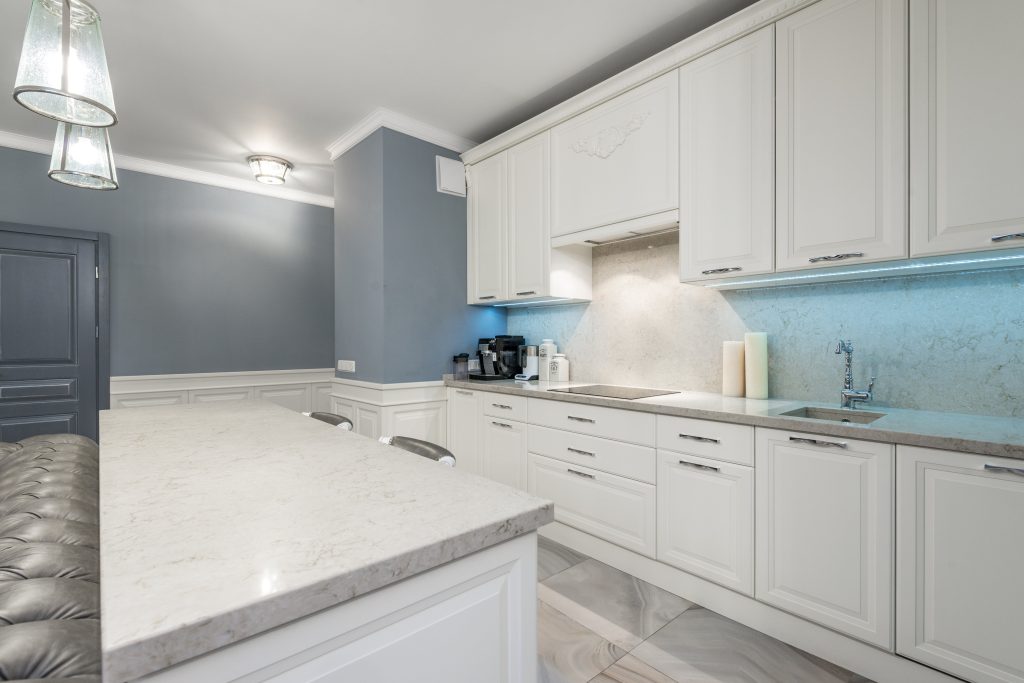
Granite vs. Quartz vs. Marble: Where Does Quartz Fall Short?
Quartz wins on maintenance and consistency, but it falls short of granite on heat resistance and falls short of both granite and marble on ease of repair. Here’s how the three compare directly on these specific challenges.
| Factor | Quartz | Granite | Marble |
| Heat resistance | Moderate, can discolor or crack under prolonged heat | Excellent, handles hot pans directly | Good, but can stain from acidic heat |
| Repair visibility | Harder to blend repairs invisibly | Easier due to natural variation | Moderate, patchable but can show |
| Price per sq ft installed | $60-$110 | $50-$90 | $75-$130 |
| UV/sun exposure risk | Can fade or yellow over time | Minimal risk | Minimal risk |
This comparison shows quartz isn’t automatically the best choice for every kitchen, particularly ones with heavy sun exposure or frequent hot pan use near the counter.
Are There Seam Visibility Issues With Quartz?
Yes, quartz can sometimes show seams more visibly than granite due to its repeating, manufactured pattern. Natural stone’s random variation actually helps disguise seams better than quartz’s more uniform design.
This becomes more noticeable on large islands or L-shaped counters requiring multiple slab sections. We plan seam placement carefully during design for quartz kitchen countertops in Crossville, TN projects specifically to minimize this visibility as much as possible.
Does Quartz Off-Gas or Have Odor Concerns During Installation?
Yes, quartz can have a noticeable odor from the resin adhesives used during fabrication and installation, particularly in the first few days after install. This typically fades within a week but can be more pronounced in poorly ventilated spaces.
We recommend keeping windows open or running fans for the first few days after installation to help the smell dissipate faster. This is a minor but real consideration for homeowners installing quartz kitchen countertops in Crossville, TN in smaller or less ventilated kitchens.
What Does Quartz Cost Compared to These Challenges?
Quartz typically costs $60-$110 per sq ft slab, with installation fees from $35 per sq ft, putting a standard kitchen project between $3,000 and $6,500 total. This is higher than granite’s typical range, which is worth weighing against the specific challenges outlined above.
Collections like Cambria and Silestone offer more consistent quality control, which can reduce some of these risks compared to lower-tier quartz brands. We always recommend discussing specific collection options for quartz kitchen countertops in Crossville, TN based on budget and how the kitchen will actually be used.
How Long Does Installation Take Despite These Challenges?
Most quartz installations still complete in 10-14 business days from template to install, similar to other stone materials. None of the challenges above typically affect installation timelines, they’re more relevant to long-term use and maintenance.
Templating, fabrication, and installation follow the same general process regardless of material, though we take extra care with seam planning and edge handling specifically for quartz. Quartz kitchen countertops in Crossville, TN projects generally stay on this standard timeline barring any special-order material delays.
FAQ
Does quartz crack easily?
Not easily, but it can chip or crack at edges from heavy impact, unlike granite’s natural resistance to this kind of damage.
Can you put a hot pan directly on quartz?
No, we don’t recommend it. Quartz can discolor or crack under prolonged direct heat exposure, unlike granite.
Does Stone Depot of Knoxville have a location in Crossville, TN?
No, our only showroom is in Knoxville. We serve quartz kitchen countertops in Crossville, TN clients through templating, fabrication, and installation only.
Does quartz fade in sunlight?
Yes, some quartz can fade or yellow with prolonged direct sun exposure, making it less ideal for sunrooms or outdoor kitchens.
How much does a quartz countertop cost?
Most kitchens run $3,000 to $6,500 total, based on $60-$110 per sq ft slab plus installation fees from $35 per sq ft.
How long does quartz installation take?
Typically 10-14 business days from template to install, similar to granite and marble timelines.
Is quartz harder to repair than granite?
Yes, matching quartz’s resin and pigment blend during repair is trickier than blending a repair into granite’s natural variation.
If you’re weighing quartz against other materials and want an honest look at the tradeoffs, Stone Depot of Knoxville can walk through pricing, timelines, and collection options during a showroom consultation. We’re located at 4723 Clinton Hwy, Knoxville, TN 37912, and can be reached at (865) 800-3524 to schedule a visit or ask about current stone availability.